From Signal to Insight — Evaluating Quantum Generative Models on Real Satellite Radar
IonQ researchers applied a quantum generative machine learning model to help detect changes in highly complex satellite image data. The results, detailed in a recently published paper, reveal that using quantum-based analysis shows promise for detecting and predicting changes in images where data is too sparse for classical methods to be effective.
This research, portions of which were executed on an IonQ trapped-ion QPU, is an example of how IonQ is working closely with Earth Observation data to explore how quantum technology can be used on real-world business challenges and application workflows.
The work comes at an important time, as the volume of satellite data of all types, including Synthetic Aperture Radar (SAR) and traditional Electro-Optical, is rapidly increasing. Governments and industries worldwide have keen interest in leveraging this data, as insights gleaned from it can power a variety of mission-critical applications. The findings of this work represent an early milestone for quantum’s ability to provide insights from satellite-based data.
The Space Data Deluge
The space sector has blasted off, and with it the amount of raw space data–petabytes worth of images daily–being generated by the rapidly increasing demand for Earth Observation (EO) satellites.
There are more than 18,000 active-payload satellites in orbit, and more than 3,100 of those have launched just this year, according to the independent website Orbital Radar. Likely thousands of active-payload satellites are used for EO applications. These numbers will only increase as more private and public space organizations launch more satellites to serve the EO demands of government, military, and industrial clients.
The growing volume of satellite data creates enormous potential to feed more insights into the applications of those organizations, but more data does not automatically translate to more intelligence. Turning raw imagery into actionable intelligence requires increasingly sophisticated processing and analysis. This is particularly true for SAR, a radar-based remote sensing technology that uses microwave signals to record backscatter to generate a detailed image. Unlike traditional satellite imagery, which depends on available light and can be obscured by clouds, SAR can collect images day or night, and in nearly all weather conditions. That dramatically expands what can be observed, but it also means that SAR data is more complex to interpret, creating new hurdles to extracting meaningful and reliable information quickly and at scale.
Adding even more complexity to the analysis task is Interferometric SAR (InSAR). This is a technique that uses phase differences across multiple SAR images to measure things like surface deformation and elevation change down to the millimeter scale.
Identifying meaningful changes across increasingly large and complex SAR and InSAR datasets requires substantial processing, filtering, and computation. That creates an interesting opportunity to explore how quantum might improve parts of that analysis workflow.
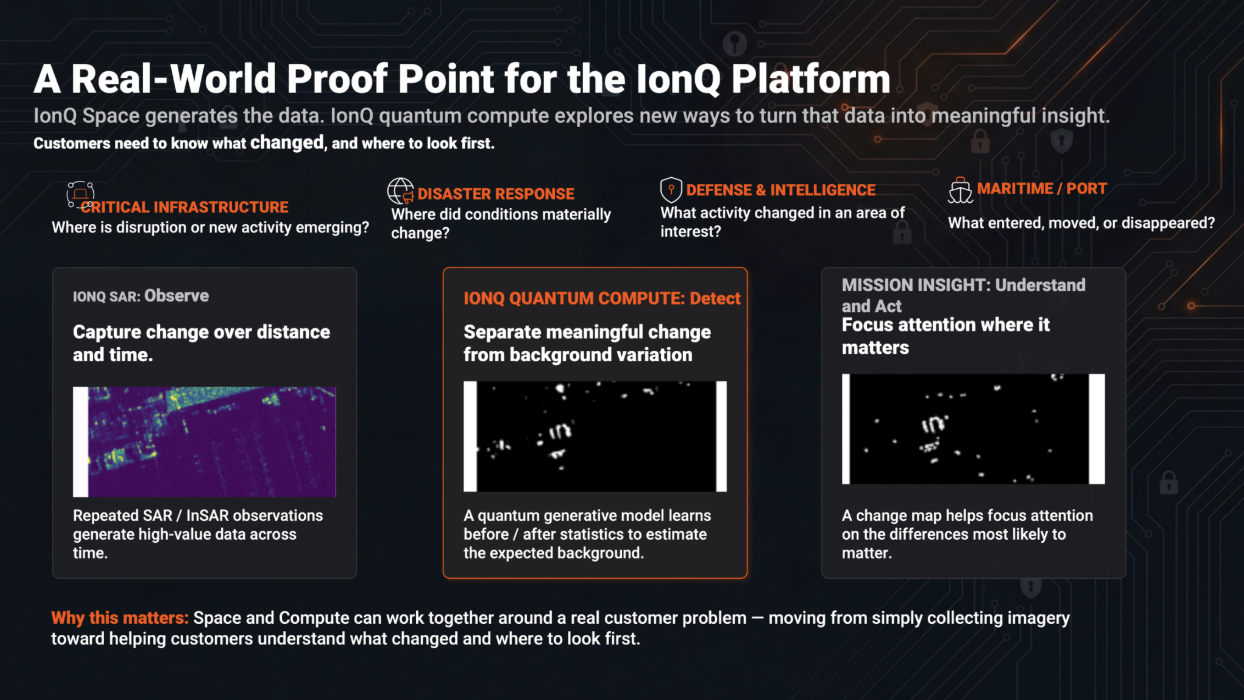
Connecting Space & Compute: IonQ’s Portfolio Strategy
Among quantum companies, IonQ is uniquely positioned to take on this type of challenge, as it is a vertically-integrated company with business units and technology platforms focused on quantum computing, quantum sensing, quantum networking, quantum security, and quantum manufacturing.
There is also a great deal of cross-pollination between these platforms, allowing IonQ’s business units to bridge capabilities and develop integrated solutions spanning hardware, algorithmic tools, and domain-specific applications. Among these units is Capella Space, which was acquired by IonQ in 2025, and operates a constellation of satellites that collect SAR data. Beyond Earth Observation, Capella’s vertically integrated spacecraft design and manufacturing capabilities also provide an important foundation for IonQ’s future space-based quantum solutions.
Earth Observation is an increasingly important part of IonQ’s space strategy, with satellite imagery supporting applications ranging from defense and intelligence to disaster response and infrastructure monitoring. As the volume and complexity of that imagery grows, so does the challenge of extracting meaningful and reliable insights from the data. These increasingly difficult analytical problems open the door for IonQ to examine where quantum may offer new benefits alongside existing classical methods.
That also makes the discussion of this research timely within the context of Quantum World Congress, as it exemplifies the event’s core focus on how quantum technology is advancing out of the lab and into the real world.
The Experiment: Testing a Quantum Generative Model on Real SAR Data
IonQ researchers aimed to explore if quantum methods could strengthen the SAR data analytics layer’s ability to draw out such insights. In doing so, it faced the challenge of disentangling background environmental noise from high-value target changes. Across all images used in this experiment, a primary task was to estimate what the second image of two images acquired at different times would have looked like had the scene not changed, and flagging the pixels that depart from it.
The quantum tool researchers chose to evaluate on this task was a Quantum Circuit Born Machine (QCBM), a quantum generative machine learning model that uses parameterized quantum circuits to represent classical probability distributions.
The datasets used were real high-resolution SAR and InSAR image pairs acquired at different times by Capella Space satellites - an X-band Stripmap amplitude pair at 1.2 m resolution captured over Marine Corps Air Station Miramar in San Diego, and a pair of interferometric coherence maps spanning the 2026 eruptive sequence of the Piton de la Fournaise volcano on Réunion Island in the Indian Ocean.
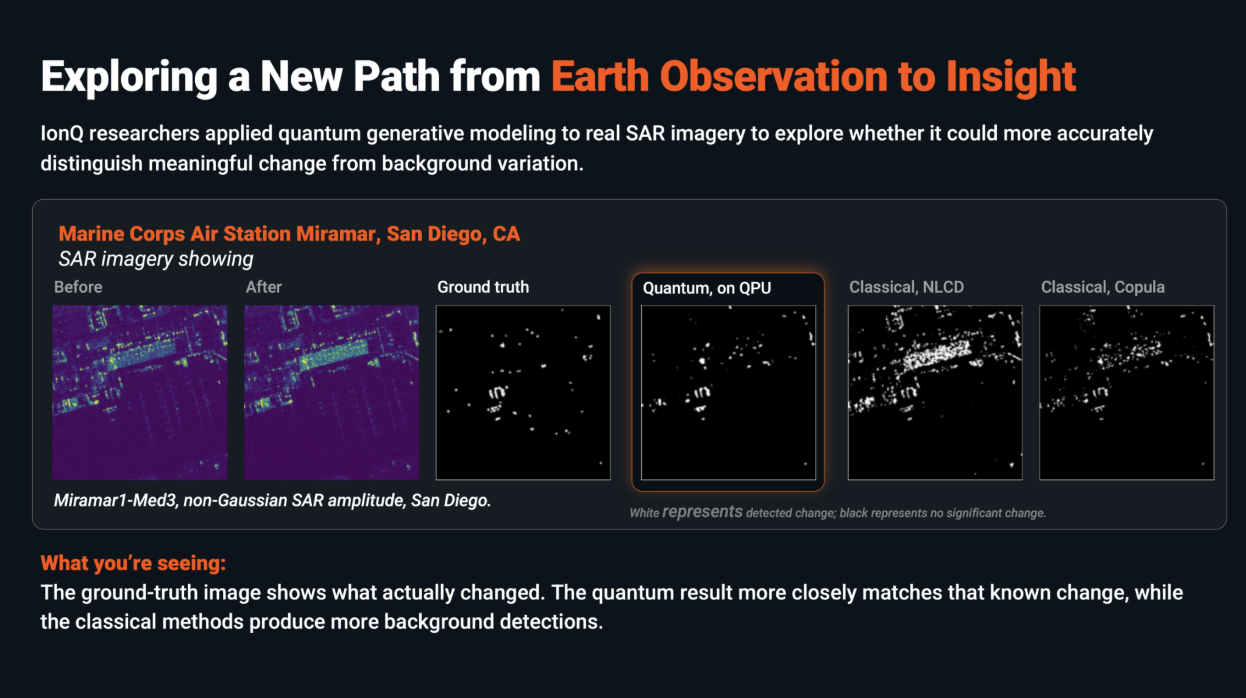
Researchers compared the QCBM’s performance on complex signal distributions to a classical baseline called the non-linear background estimator (NLBE). They replaced the empirical conditional expectation at the heart of the background estimator with one sampled from a QCBM trained on the joint distribution of before and after image intensities in copula space, and then tested it against classical estimators. Tests were carried out under three methods - classical models, quantum models on an ideal simulator, and quantum models run on an IonQ trapped-ion QPU. All measurements were assigned a filtered F1 score, a common machine learning metric.
The Findings: How Quantum Performs Vs. Classical Baselines
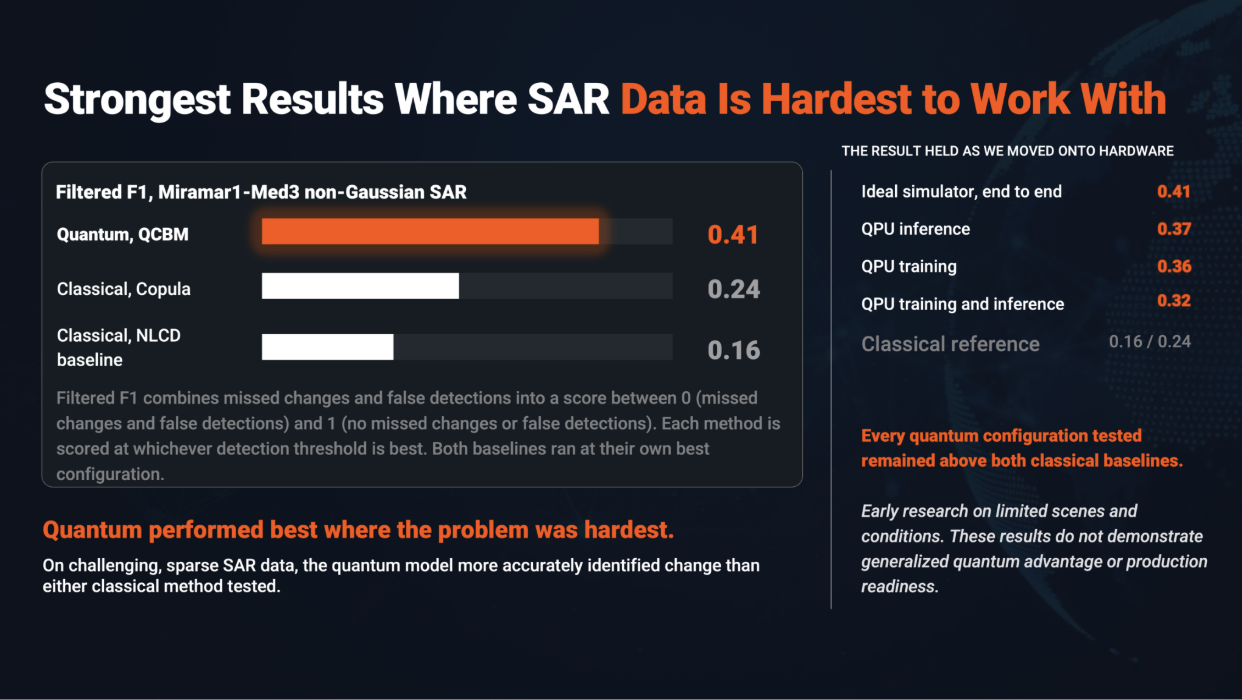
Researchers found that across all datasets, the QCBM achieved higher F1 scores than the classical baseline on image pairs characterized by non-Gaussian intensity distributions–those that were the hardest to work with because they contained strongly skewed pixel distributions. In contrast, for datasets with approximately Gaussian intensity distributions–putting them within the reach of classic analysis–results show that QCBM and classical estimators achieved comparable change-detection performance.
The degree of the improvement varied considerably between experiments, and the pattern of that variation suggests the quantum method shows potential benefit on the preprocessing image configurations with strongly skewed pixel distributions. On the InSAR dataset from the volcano, QCBM and classical methods attained similar peak filtered F1 scores, while the QCBM threshold response indicated robustness over a broad operating range.
What all that means from a workflow perspective is that quantum outperformed classical methods, and benefitted the overall workflow in situations where image data was sparse. Even under conditions where data sparsity was not an issue, the quantum model matched the performance of classical approaches, a significant finding in and of itself. These results support QCBM as a competitive generative model for image change detection across both simulator-based and QPU inference settings.
Strategic Takeaway: Mapping a New Frontier
The results of this experiment represent an encouraging early milestone in measuring how quantum technology can perform within the Earth Observation analysis workflow, with the bottom line being that it performed better than classical baselines under some conditions, and was competitively on par with it under others.
The results of this research also contribute to the blueprint that we continue to develop for how hybrid quantum-classical pipelines fit into the space sector. As we continue to prove the ability of quantum algorithms and models to perform better or in parity with classical tools, hybrid approaches will be more likely to be implemented in more aspects of the sector.
Space is not the final frontier for quantum technology, but it is one of many frontiers IonQ continues to explore and map out, and among several in which quantum could have near-term applicability. We have shown that quantum can be meaningfully evaluated on a real-world SAR problem, and deliver promising results compared to classical using three different approaches. The next step for IonQ in this case is to keep testing where each approach works best, and to define where quantum can add value within real-world analytic workflows.
Note to Investors Regarding Forward-Looking Statements
This article contains forward-looking statements. All statements contained in this article other than statements of historical fact are forward-looking statements, including statements regarding IonQ’s competitive advantage. In some cases, you can identify these statements by forward-looking words such as “can,” “could,” “may,” “next,” “new,” “future,” “near-term,” “positioned,” “explore,” “map,” “suggest,” “promise,” and other similar expressions. These statements are only predictions based on our expectations and projections about future events as of the date of this article and are subject to a number of risks, uncertainties and assumptions that may prove incorrect, any of which could cause actual results to differ materially from those expressed or implied by such statements, including, among others, those described under the heading “Risk Factors” in our annual Report on Form 10-K for the year ended December 31, 2025 and our Quarterly Report on Form 10-Q for the quarter ended June 30, 2026 filed with the Securities and Exchange Commission. New risks emerge from time to time, and it is not possible for our management to predict all risks, nor can management assess the impact of all factors on our business or the extent to which any factor, or combination of factors, may cause actual results to differ materially from those contained in any forward-looking statement we make. Investors are cautioned not to place undue reliance on any such forward-looking statements, which speak only as of the date they are made. Except as otherwise required by law, we undertake no obligation to update any forward-looking statement, whether as a result of new information, future events or otherwise.

