Holdover Explained: When GPS Stops Setting the Clock
At a Glance
- Most modern clocks used in federal or defense operations rely on GPS timing to provide consistent corrections and avoid drift—or deviation from true time.
- Atomic clocks are a specific type of clock that uses an atom’s frequency as the “tick” that marks the passage of time. They are incredibly accurate, but even atomic clocks drift.
- When a clock loses its GPS timing connection, it enters a state called holdover. Holdover describes how long a clock stays within a given error limit without correction from an external source, such as GPS. The limit depends on what the clock is supporting.
In high-precision operations, accurate time matters far beyond punctuality: If frequency-hopping radios don’t have matching clocks, they cannot land on the same channel at the same time. If an encrypted message doesn’t have a timestamp within a specified window, encrypted nets won’t accept it. A signal arriving at three receivers can only be translated to a location because the receivers agree to the nanosecond on when it arrived.
GPS position itself is a timing measurement: a receiver finds its range to each satellite by timing the signal’s arrival, so a nanosecond of clock error is about a foot of range error. Missiles, sensors, aircraft, ships, and artillery all rely on atomic clocks aboard GPS satellites for nanosecond timing.
GPS timing issues constant corrections, preventing individual clocks from drifting slowly out of sync. But what happens when the signal stops? Whether due to a jammer or a system error, each clock must keep time on its own.
Holdover describes how long a clock’s time remains useful. Most fielded holdover is sized for an outage measured in hours, but the denial scenarios now written for contested theaters run from days to weeks.
This piece goes deeper into holdover, how it's determined, and what that gap demands of a clock.
Why Extended Holdover Matters
The paragraphs above describe mission-critical systems—all dependent on timing. They can serve the mission during a GPS outage only as long as their clocks do. Holdover measures just that: how long a clock stays accurate enough to be useful for its mission once it loses GPS connectivity.
Most fielded clocks hold for hours, just long enough to find a jammer or wait out a system glitch. However, the denial scenarios now written for contested theaters run for days or weeks. Extended holdover seeks to close the gap between the holdover we typically have and the holdover an increasing number of scenarios require.
A clock that holds for days without GPS means more than just accurate timing in the field. It lets a ship’s combat system keep fusing radar and passive sensor tracks through jamming, allowing the weapons officer to engage one confirmed track instead of three disagreeing ones. It keeps a frequency-hopping net in step without the net control station transmitting every few hours, so the net stays up and stays quiet when being heard means being found. It ensures a geolocation net of several platforms agrees to the nanosecond on when a signal arrived, so the jammer that took GPS away becomes a target.
And it also checks the signal itself: a receiver that can trust its own clock can see a spoofed GPS signal disagree with it and refuse to follow, so the spoofer gets nothing for the effort.
When a program office seeks a clock with extended holdover, these are the capabilities they’re buying—and why a working understanding of holdover is so important for buyers.
GPS: Atomic Clock Time, Without the Atomic Clocks
GPS.gov describes the timing service as “atomic clock time, without the atomic clocks.” That’s the bargain we’ve made by basing everything from weather radars to smartphone networks on GPS timing. We get incredibly accurate timing—so long as the clocks receiving that time can receive a GPS signal.
The clocks on GPS satellites aren’t unique, and left alone, they would drift like any other atomic clock. What makes GPS time accurate is the correction loop around them. The U.S. Naval Observatory measures each satellite clock against its Master Clock, and the Space Force uploads daily corrections to each satellite. The navigation message your receiver decodes carries those corrections.
Therefore, “GPS Time” isn't any single clock; it is a weighted average of satellite and ground clocks.
Every GPS-disciplined clock on the ground works the same way one level down. Its oscillator, usually quartz or rubidium, is nudged continuously to agree with the satellites.
How Long Can Your Clock Stand Alone?
Every clock has two key components: something that ticks at a steady rate, and a counter that adds up the ticks. In a quartz clock, the ticking comes from a vibrating crystal; in an atomic clock, it is an atom absorbing energy at one exact frequency. The tick rate is the clock's frequency. If the rate is even slightly off, the counter runs slightly fast or slow, and the gap between the clock and true time grows with every tick.
An optical atomic clock adds a third component. Because its atom ticks at a frequency far too high for electronics to count, a laser that converts the optical frequency down to a microwave signal, called a frequency comb, sits between the atom and the counter.
Regardless of a clock’s specific mechanism, frequency drifts over time. GPS consistently corrects timing: the receiver compares its own count to the satellites' and trims the oscillator until the two agree.
In holdover, those corrections stop, and the rate error drifts from the moment it loses GPS signal. The math is unforgiving: A clock running fast by one part in a billion is 86 microseconds off after a day.
The time error grows faster than the clock itself drifts. Oscillators age: their tick rate slowly changes over time, and quartz is especially prone to this. Because time error is the running total of rate error, a rate that keeps changing produces a time error that grows with the square of the elapsed time. The error on day two is four times the error on day one. By day five, it is twenty-five times the day one amount. Temperature swings and vibration, such as those in a fielded environment, compound the problem. So does a recent power cycle: an oscillator takes hours to settle after it is switched on, which is why a radio that was just powered up drifts faster than one that has been running all week.
So the holdover question has three variables:
- Your tolerance: how much time error your mission can absorb before something stops working.
- The clock's stability: how fast it drifts on its own.
- Time dark: how long the signal will be gone.
The first two variables depend on you and your vendor. The third, however, often depends on external factors. Or, in some cases, your adversary.
The Right Tolerance for the Mission
The first variable, your tolerance, depends on how your mission uses time.
Seconds: radios and crypto nets. A frequency-hopping net such as SINCGARS changes frequency about 100 times a second. According to the multiservice tactical radio manual, time of day “synchronizes the FH.” GPS time is the recommended source, and the net control station should transmit at least every four hours to keep every station in step. The 2002 edition stated the tolerance in numbers: each station “must be within plus or minus four seconds of the net sync time to communicate,” and a radio that drifts further can recover itself through late net entry only while it is still within 60 seconds.
Microseconds: fused tracks. When two sensors report the same target, the fusion engine aligns their observations using timestamps; for a target moving at a few kilometers per second, a microsecond of disagreement is millimeters. At a larger scale, a millisecond translates to meters. That discrepancy is enough to degrade association, filtering, and the fused track.
Today that agreement comes from GPS. GPS is also often the first thing an adversary attacks in any scenario that also includes a missile.
Nanoseconds: geolocation and coherent sensing. To locate an emitter based on differences in signal arrival time across receivers, systems need clocks that agree to the nanosecond. A nanosecond of clock error is about a foot of range error; NIST describes it as satellite clocks needing to hold 3.3 nanoseconds to keep position error under a meter.
The holdover question underpins all tolerances. Most fielded PNT hardware addresses this with a chip-scale atomic clock, which CISA estimates holds within 100 nanoseconds for about two hours under ideal conditions, or within a microsecond for most of a day. However, the denial scenarios mission owners are planning for now run multiple days to weeks—far beyond the two-hour threshold chip-scale atomic clocks were designed for.
Holdover as a “Lie Detector” for Spoofed Signals
A clock with excellent internal time-holding can also detect when a signal is wrong. This proved to be instrumental in a well-documented 2016 case, though no adversary was involved. During a satellite retirement in January 2016, a ground-software error placed the GPS time message off by thirteen microseconds, although the core navigation systems continued holding time normally.
However, timing units capable of keeping clear time on their own flagged the disagreement against their internal clocks and held over. The systems that kept following the signal without a fallback failed.
Though this situation did not involve an adversary, it serves as a cautionary simulation of a very plausible attack. A spoofed GPS signal carries spoofed time; it could happen so slowly that no immediate threshold or trigger tripped. Without excellent, trustworthy holdover, timing could drift without detection.
Holdover not only keeps clocks on track while the signal is being restored, but also provides a source of truth to detect a false signal before systems are disrupted.
What to Ask for, and Where Optical Clocks Fit
In general, holdover specifications come down to error threshold and corresponding holdover time, such as ten microseconds over eight hours or one nanosecond over ten days. However, the Department of Homeland Security recommends that maker-issued resilience claims include additional information: the error limit; how long the clock holds it; how confident the maker is in that figure; and how quickly the system recovers when GPS returns. It is also worth asking whether the figure is compensated or raw. Most published holdover specs include correction for the clock’s known drift that makes the clock appear far more precise than the hardware is on its own; IonQ publishes uncompensated numbers for the hardware itself.
An iodine optical atomic clock raises the ceiling on this primary holdover specification. It uses a reference that ticks tens of thousands of times faster than the microwave reference inside a rubidium or cesium clock. A disturbance of the same size throws off a much smaller fraction of each tick, so the clock drifts more slowly.
CISA publishes how long rubidium and cesium clocks take to drift 100 nanoseconds once GPS is gone:
- About six hours for a rubidium clock
- Eleven days for a standard cesium beam tube
- Seventy-two days for a high-performance cesium beam tube
These clocks typically operate in a stationary, climate-controlled laboratory setting. Ruggedized versions exist, and their holdover varies with the configuration. However, these improved figures come from larger units that are less mobile and more difficult to deploy.
In 2022, DARPA set a goal when it launched its optical clock program: nanosecond holdover for a month from a unit that fits on a ship or in a field tent. IonQ's Evergreen-05 resulted from that program: an iodine optical atomic clock roughly the size of a cake box that holds one nanosecond for ten days on a moving platform—100 times tighter than cesium’s figure for a similar duration.
Its rack-mount sibling, the Evergreen-30 pictured below, drifted about 300 picoseconds a day over 20 days at sea in trials published in Nature, with no climate-controlled room. Nanosecond-level error, held for days, in a compact unit, in the field, is a combination no rubidium or cesium clock offers today.
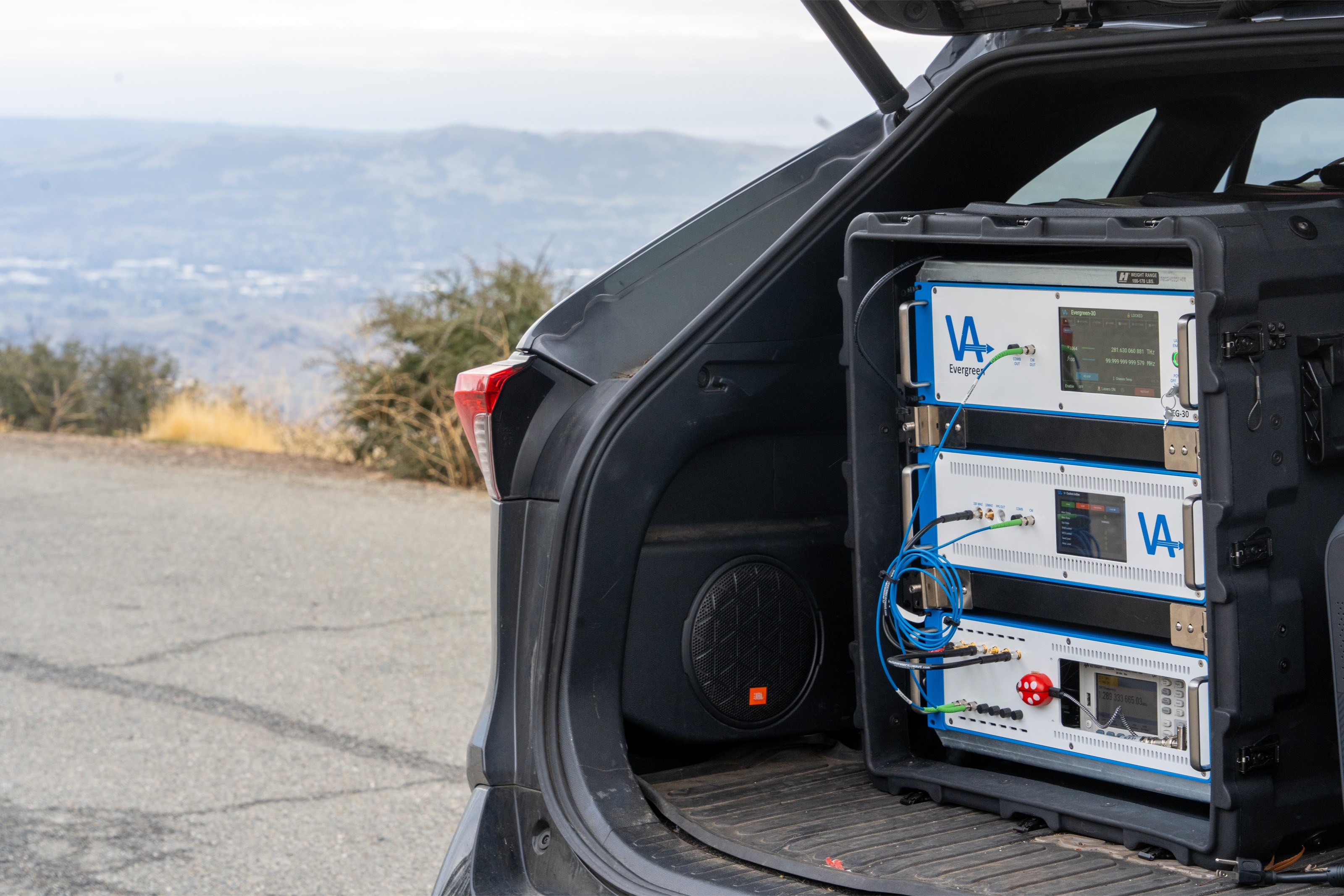
Beyond durability and precise holdover, operators should also look for a device with a clear readout that shows three additional indicators: how long a clock has been in holdover, its probable drift, and which networks are at risk as a result. These figures allow a clock to function both as a steady instrument and as an alert for impending errors.
None of this tells a ship or aircraft where it is. Position without GPS still comes from additional sensors. However, those sensors, as well as every radar, radio, and data link on the platform, depend on a clock that hasn’t slipped, so time is the dependency to secure first.
Choosing the Clock
The questions in this piece are the ones to put to any vendor. How long does the clock hold, to what error, in what environment, and who measured it? What does the operator see? Which of those answers hold up in a Humvee, in turbulence, or after the clock has been dropped, rather than sitting on a lab bench?
When you choose a vendor, it’s critical that they can answer all of the above questions.
IonQ briefs program offices and mission owners on exactly these questions, including how optical clocks compare with other options on the market, what the integration path looks like, and where holdover fits in a wider assured-PNT architecture. Please contact us if you would like to request more information.
If you found this article useful, subscribe to the Mission Ready Quantum newsletter for monthly updates on policy, technology, and quantum news for federal stakeholders.

