How qLDPC with Scheduled Error Correction Unlocks Faster Fault-Tolerant Quantum Computers

At a Glance:
● The Core Innovation: IonQ researchers (Webster & Delfosse) have combined simple cat states, novel classical scheduler codes, and a hybrid physical/logical execution strategy to address a long-standing speed bottleneck in Quantum Low-Density Parity-Check (qLDPC) error correction codes. https://arxiv.org/abs/2607.16166
● Key Findings:
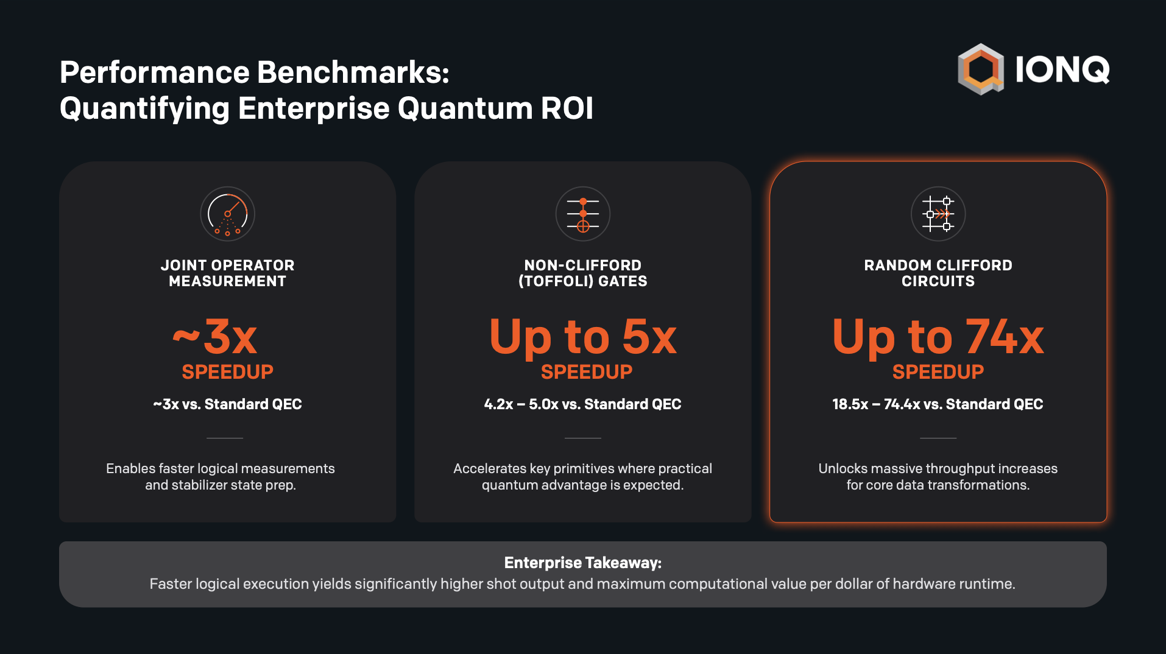
○ New protocols which allow for multiple logical measurements to be performed jointly. This leads to a speedup of up to 3x for state preparation and logical gates versus sequential logical measurements.
○ New logical CliNR (Clifford Noise Reduction) protocol to apply logical gates adapted from the physical CliNR scheme.
○ Logical CliNR achieves a speedup of up to 74x for logical Clifford operations and up to 5.0x for critical non-Clifford logical Toffoli gates versus sequential logical measurements.
● Enterprise Implications:
○ Higher Value Per Machine: These innovations can result in faster execution of customer workloads on our future fault-tolerant quantum computers, which for enterprises can translate to significantly higher shot output and computational value per dollar spent on machine runtime.
○ Foundations for Practical Quantum Advantage: Accelerating Toffoli gates (key primitives for algorithms where quantum advantage is expected) and Clifford operations (which transform data between non-classical components) provides a realistic path toward executing deep fault-tolerant quantum algorithms sooner than previously anticipated.
Getting the Most Out of qLDPC
IonQ researchers have devised a way to realize the full benefits of high-rate quantum Low-Density Parity-Check (qLDPC) codes without being slowed down by their processing limitations, bringing us closer to practical fault-tolerant quantum computing (FTQC).
Researchers Mark Webster and Nicolas Delfosse demonstrated how to implement logical Clifford operators efficiently on qLDPC codes using relatively simple cat states and joint measurements governed by classical scheduler codes. By pairing this with a new logical CliNR protocol, IonQ achieves up to a 74x speedup for logical Clifford operations and up to 5x for critical Toffoli gates compared to traditional sequential methods. The result: faster logical execution, higher shot output, and greater computational value per dollar spent on quantum To deliver commercially meaningful quantum advantage in fields like materials science, financial modeling, and logistics, quantum computers must achieve fault tolerance. Historically, the primary candidate for fault tolerance has been the surface code, which uses local 2D grid checks to protect logical qubits. However, surface codes carry a massive hardware tax, often requiring hundreds or thousands of physical qubits per single logical qubit. Enter qLDPC—and its operational catch.
Quantum Low-Density Parity-Check (qLDPC) codes drastically reduce this physical overhead by enabling non-local interactions, allowing significantly more logical qubits to be packed into the same physical hardware footprint. The catch? Moving from simple 2D neighbor checks to densely packed, non-local qLDPC blocks makes performing operations on logical information dramatically more difficult. Multiplexing logical operations introduces severe logical latency and round delays during error correction, threatening to bottleneck execution speed. Solving this operational complexity without adding massive hardware overhead has remained one of the central hurdles in fault-tolerant quantum computing—until now.
IonQ’s Breakthrough for Faster qLDPC
Previous attempts to speed up qLDPC operations required the use of complex ancillary resource states to execute logical qubit measurements. IonQ researchers have carved an easier path, demonstrating that simple cat states are sufficient when paired with smart Scheduling.
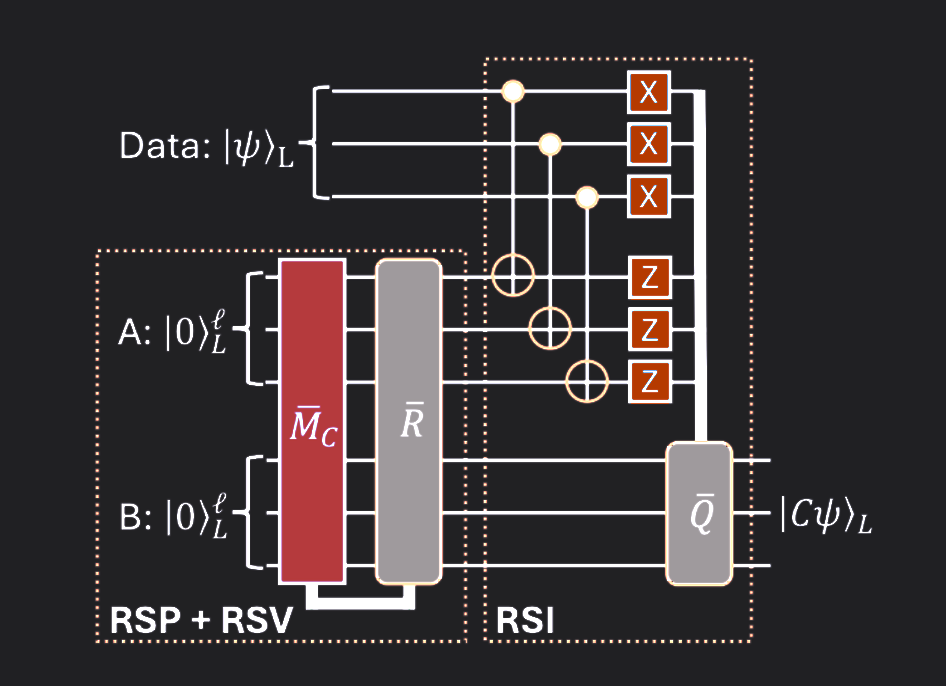
Instead of measuring logical operators one at a time, which incurs massive error-correction round delays, IonQ proposes measuring L commuting logical operators jointly, and using classical codes to detect and correct errors simultaneously. Employing joint measurement significantly reduces the number of physical measurements required across L commuting operators.
The magic ingredient in this approach is using classical codes to specify a schedule of measurements. The schedule is a series of products of logical Paulis we wish to measure. By carefully designing this scheduler coder, the total number of measurements required per logical Pauli can be minimized, thus improving processing time. This sort of scheduling approach is going to sound familiar to anyone in the corporate enterprise networking world, as it is similar to how network packet scheduling optimizes bandwidth usage without overloading the processing stack.
Accelerating Logic Gates
Achieving faster and more reliable logical measurements is part of the accomplishment. To achieve the speed-up of up to 74x for random Clifford circuits and up to 5x on Toffoli gates, IonQ researchers introduced a new variant of the CliNR partial error correction method.
CliNR is a low-qubit-overhead method that applies a Clifford operation by preparing a state offline, verifying it, and then applying the operation via state injection. Using CliNR in the interest of pursuing a gate performance speedup might not come off as an obvious choice, as CliNR itself can lead to an increase in execution time. But, in this case, researchers took a different approach to CliNR by applying part of the scheme at the logical level and other parts at the physical level to improve execution speed.
Researchers also leveraged IonQ’s new logical measurement protocols to merge the resource state preparation and verification steps involved in CliNR. While standard CliNR usually applies to noisy physical circuits, these adaptations allow the CliNR concept to apply logical gates in a fault-tolerant manner without temporal overhead.
To evaluate performance for qLDPC, researchers considered two qLDPC codes–Q70 and Q102–within the Walking Cat physical architecture, which is IonQ’s blueprint for a fault-tolerant, trapped-ion quantum computer. The measurement of L=10 and L=20 commuting logical operators consumed an average of only 2.1 and 1.7 cat states, respectively, per logical measurement. The results also apply to trivial logical measurement, that is stabilizers, which leads to a protocol for fast preparation of a stabilizer state through the measurement of its stabilizer generators.
Performance Benchmarks: Quantifying the ROI for Business Leaders
The enterprise takeaway from all this is that achieving a 74x speedup on critical subroutines substantially increases shot output per machine, yielding greater computational return on hardware investment and laying the groundwork for accelerating end-to-end fault-tolerant algorithms.
Streamlining the Enterprise Roadmap
This research illustrates how IonQ incorporates software/classical code layers (like scheduler codes) to drive greater hardware efficiency. With these innovations, IonQ is bringing faster execution to qLDPC architectures, making more efficient use of physical qubits. This will result in systems that can provide clear, practical enterprise value in a wide range of industries and on a variety of applications.
To bring the industry into the FTQC era and become more enterprise-relevant, platform vendors must shift away from pure physical qubit counts or raw T1 times, and put more focus on factors like Logical Execution Rate (LER) and QEC scheduling efficiency. Doing so will help us make the most of our error correction practices. As qLDPC architecture advances from R&D to achieve a prominent place on commercial hardware roadmaps, innovative hardware-software co-design will differentiate viable commercial systems from legacy research testbeds.
Even though this preprint was only published recently, this work already found an application to speed up Clifford operations in our recent specialized walking cat architecture optimized for breaking 256-bit elliptic curve cryptography. This research was summarized in a recent blog post, and discussed in much greater detail in this paper.
Note to Investors Regarding Forward-Looking Statements
This article contains forward-looking statements. All statements contained in this article other than statements of historical fact are forward-looking statements, including statements regarding timeline to practical fault-tolerant quantum computing. In some cases, you can identify these statements by forward-looking words such as “will,” “can,” “closer,” “blueprint,” “new,” “bring,” “roadmap,” and other similar expressions. These statements are only predictions based on our expectations and projections about future events as of the date of this article and are subject to a number of risks, uncertainties and assumptions that may prove incorrect, any of which could cause actual results to differ materially from those expressed or implied by such statements, including, among others, those described under the heading “Risk Factors” in our annual Report on Form 10-K for the year ended December 31, 2025 and our Quarterly Report on Form 10-Q for the quarter ended June 30, 2026 filed with the Securities and Exchange Commission. New risks emerge from time to time, and it is not possible for our management to predict all risks, nor can management assess the impact of all factors on our business or the extent to which any factor, or combination of factors, may cause actual results to differ materially from those contained in any forward-looking statement we make. Investors are cautioned not to place undue reliance on any such forward-looking statements, which speak only as of the date they are made. Except as otherwise required by law, we undertake no obligation to update any forward-looking statement, whether as a result of new information, future events or otherwise.

