PQC and QKD: What Mission Owners Need to Know About Quantum-Era Security
At a Glance
- Post-Quantum Cryptography (PQC) is new key exchange math, deployed as software, that replaces today’s quantum-vulnerable public-key algorithms.
- Quantum Key Distribution (QKD) is hardware that uses single photons to deliver encryption keys while detecting eavesdropping, suited to a small number of high-value links.
- Federal policy requires PQC, with deadlines in 2030 and 2031. QKD is not required, but it can be layered on PQC for a small number of long-lived, high-value connections.
Shor’s algorithm, which can break the public-key cryptography that protects almost all internet and government traffic, has been around since 1994. By IonQ’s own estimate, cracking a single 256-bit elliptic-curve key, worked through on Bitcoin’s secp256k1 curve, would take about 26 days per attempt on a trapped-ion quantum computer with 1,457 logical qubits on roughly 20,000 physical qubits.
While that quantum computer doesn’t exist today, the White House’s own migration guidance says one may arrive in the coming decade. Expert estimates of the computing requirements for such a machine keep shrinking.
Two possible solutions exist: Post-Quantum Cryptography (PQC) and Quantum Key Distribution (QKD). Executive Order 14412 requires high-value assets and high-impact systems to use PQC for key establishment by December 31, 2030, and for signatures by December 31, 2031. The order names only PQC.
Although computers capable of running Shor’s algorithm may not be ready by 2030, the mandated deadline may still be too late to protect vulnerable, long-lived secrets. The Executive Order itself names the risk of adversaries “collecting United States information now, and decrypting it later” once large-scale quantum computers are able to—an attack known as “harvest now, decrypt later.” Some operational and system data will still be sensitive when that day comes.
PQC and QKD technologies, however, can protect systems now and against future attacks.
How Do Current Systems Approach Cryptography?
In modern cryptography, every secure connection has two functions. It scrambles the data and, before that, agrees on the key used to scramble it.
The scrambling itself, called symmetric encryption, uses the same key at both ends and holds up against quantum computers. The problem is the key agreement. Two parties who have never met must agree on a secret over a line anyone can tap. Since the 1970s, this has been achieved with public-key cryptography: math that is easy to run forward and effectively impossible to reverse. The same math produces digital signatures, which, for example, let a system know a software update came from its vendor.
Shor’s algorithm can solve the reverse problem for the cryptosystems currently in use, making these public-key-secured messages vulnerable.
PQC vs QKD: What They Are and How They Compare
PQC and QKD are two different approaches to solving the problem Shor’s algorithm poses to public-key-secured messages. PQC is a software-focused solution suitable for many general-use applications, while QKD requires specialized hardware to protect select high-value communications.
PQC itself isn’t quantum technology. Rather, it is a specific family of new public-key encryption techniques designed to withstand attack by a quantum computer. It replaces the one-way mathematical problems that Shor’s algorithm breaks. The symmetric encryption that scrambles the data itself is not replaced; it stays the same.
Although PQC algorithms are software and can run on existing systems, deploying them across an enterprise is not just a software update. Keys must be generated, distributed, rotated, and audited across every system that uses them, typically through key-management and orchestration platforms, often backed by dedicated hardware. That layer is also where PQC-based key distribution and QKD-delivered keys meet, which matters in the next section.
QKD, by contrast, is a hardware approach. It sends single photons over fiber or through the air to produce a shared key, relying on a basic property of quantum states: when a quantum state is observed, it changes. As a result, an eavesdropper who intercepts the photons leaves errors in the shared key that the two ends can detect by comparing a sample.
Unlike PQC, QKD is a true quantum technology. It replaces the public-key key-agreement step with physics—the two ends arrive at a shared key without any math an adversary could reverse. Then, the data is scrambled with ordinary symmetric encryption. Also, unlike PQC, QKD does only one job. It cannot encrypt data, produce digital signatures, establish online identities, or complete similar tasks. QKD requires dedicated hardware at both ends of the link, and it still needs the two ends to authenticate each other, which has to come from PQC or a pre-placed key.
How PQC and QKD Work Together
Used together, they form a layered defense that works in two different ways. PQC works like a lock: it adds new math to every system that adversaries can’t reverse. QKD is the courier who hands over the key in person. The key never passes through anything an adversary could record and reverse later, and if anyone interferes along the way, both ends can tell.
PQC and QKD provide complementary approaches to quantum-safe security. While PQC can be deployed independently, QKD uses quantum physics to establish shared secret keys and requires an authenticated classical communication channel, which can be supported by pre-shared keys or post-quantum cryptographic authentication.
PQC relies on math believed to be very hard to break, but even well-vetted cryptography can be imperfect. NIST’s primary choice for key establishment, ML-KEM, is built on computations on lattices. However, during the same selection process, SIKE (a candidate that had advanced to the fourth round) was broken outright in 2022. NIST later chose HQC as a backup in 2025. HQC and ML-KEM rely on different mathematical foundations, so a single break can’t take out both the primary and fallback approaches.
For high-value secrets, a layered approach adds even more protection. Because QKD rests on properties of physics, it has a different failure mode. By layering QKD on PQC, the secrets are more reliably secured; even if PQC math fails, a session can remain secure.
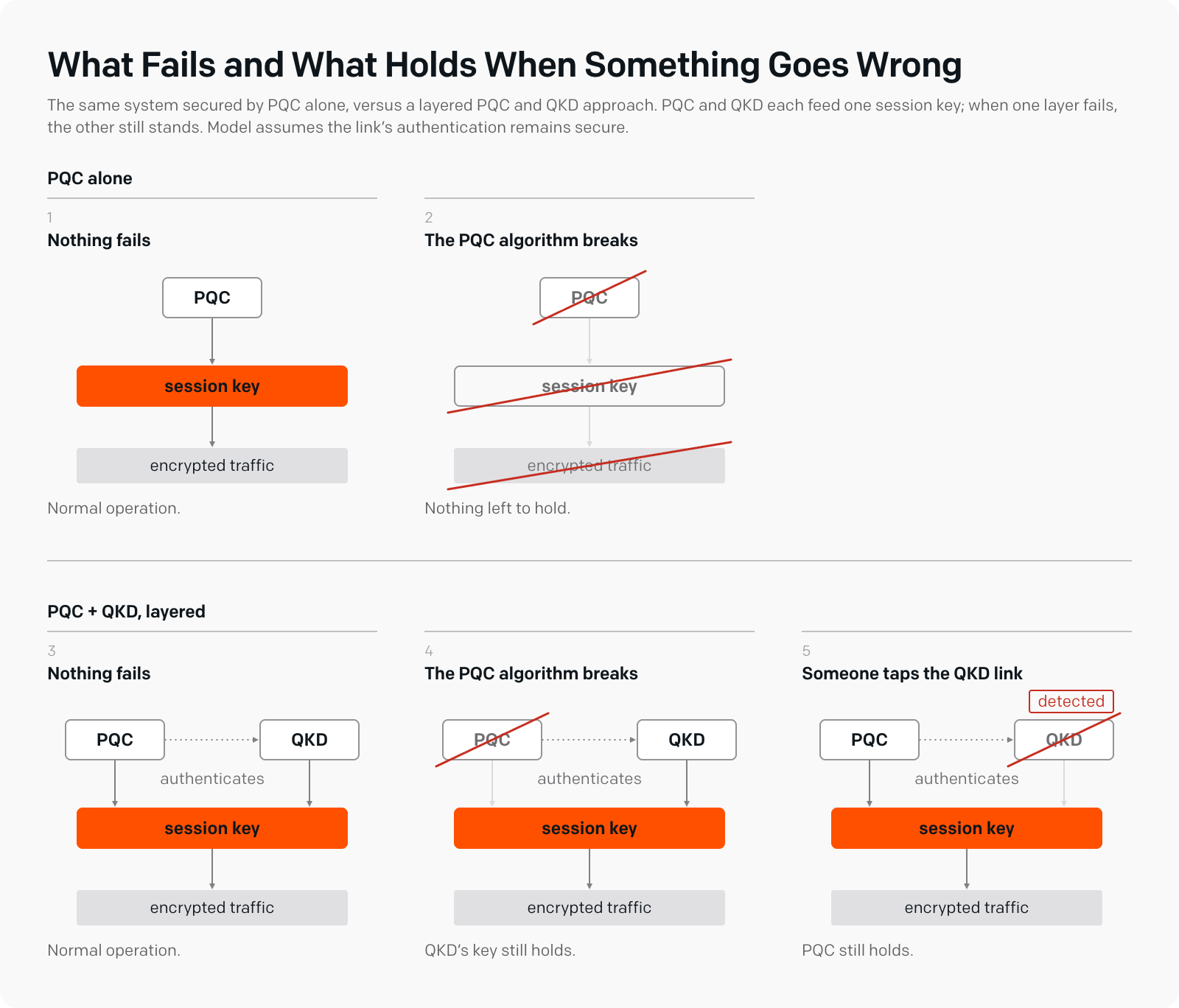
In practice, both the PQC and QKD layers must be orchestrated to form a cohesive layered approach. Both PQC and QKD produce keys, and those keys have to be delivered to the systems that use them, rotated, and retired across the whole system. A key management and orchestration layer owns that process: it takes keys from PQC key establishment and from QKD hardware, hands them to the encryptors, VPNs, and hardware security modules already in place, and keeps the two layers in step. The encryption itself does not change; only the source of the keys does. The orchestration layer is also where the two layers come together: the two shared secrets are combined to derive a single session key, so the session remains secure if either one holds.
A layered approach uses PQC as the broad foundation across every system and deploys QKD for high-value secrets where the link allows—and this split is in use today. On IonQ’s own network, QKD protects the local fiber links among its Geneva sites, while PQC secures the international VPN connections between Geneva and Seoul. Slovakia’s national quantum network pairs a QKD metro cluster with a combined QKD–PQC cross-country link, and Romania’s national QKD network runs 36 links across more than 1,500 kilometers.
When Is QKD Needed?
The NSA does not currently recommend QKD for national security systems unless its listed limitations are overcome, and NSS owners should consult the NSA before pursuing any implementation. For defense systems, the Department of War’s strategy goes further: it lists QKD, quantum networking, and solutions that combine QKD with other key establishment protocols among technologies that will not be used as security measures for quantum resistance.
However, that does not mean it isn’t worth pursuing—if your circumstances meet certain criteria:
- You control both endpoints for transmission: Because QKD is point-to-point hardware, it requires secure, compatible hardware at each end of the link. That means you must control both points, either through direct ownership, a managed service, or a third-party network operating on your behalf.
- An optical path exists between them: QKD keys can be exchanged over fiber across a few hundred kilometers, via free-space optics for shorter line-of-sight links, or via a satellite pass for longer distances. However, today’s satellite QKD links are relatively slow, and generally function only when the sky is clear. Unless the link is entanglement-based, the satellite itself holds the keys and acts as a trusted node, so it has to be trusted like any other relay. The optical terminals that make space links possible are maturing much faster than the quantum layer on top of them, and that transport layer is the foundation for quantum networking over space links as it matures. For now, your sites must be within fiber range, or you must commit to securing a relay station between them.
- The secret needs to be kept for decades: If someone records a transmission today, its secrecy years from now depends on the key exchange that protected it. QKD establishes that key with physics rather than public-key math, so a future break in the algorithm doesn’t expose the recording. The data itself is still protected by symmetric encryption and sound key management, but QKD changes how the key gets there.
- You have a budget on top of the PQC budget: You can’t swap QKD for PQC, so any budget must be in addition to any budget allocated for PQC.
For high-value secrets, QKD can provide an additional security layer. It can be useful for data-center-to-data-center links, command facilities, and backup sites for critical labs.
The Bottom Line for Mission Owners
The federal mandate only requires PQC. For the high-value assets and high-impact systems covered by Executive Order 14412 (national security systems are excluded), PQC must be used for key establishment by December 31, 2030, and for signatures by December 31, 2031. National security systems and defense systems run on independent schedules.
PQC implementation begins with a thorough inventory of where cryptography is in use to ensure a complete list prior to migration. Owners need to review all files, applications, devices, vendor products, and dated data that may be sensitive after the deadline.
While the deadlines represent the final date migration must be completed by, owners also need to consider what data needs to last, and how long. For data that will remain sensitive for decades, QKD can provide an extra layer of security.
This migration will not be the last. NIST’s schedule for migration and updates runs to 2035, and systems should be built so encryption algorithms can be swapped without re-qualifying the whole system. QKD fits within the same long-term view—while it isn’t necessarily a purchase to make during this migration, it is a worthwhile question to raise for high-value risks.
PQC is the floor all mission owners must meet—a software solution that replaces the old, at-risk encryption math in use today. QKD is a hardware solution suitable for select, high-value data. The strongest architectures are designed with both in view from the start.
To learn more about post-quantum security and protecting networks in the quantum era, review our recent blog, Protecting the Network Before the Network Is Ready.
If you found this article useful, subscribe to our Mission Ready Quantum newsletter for monthly updates on policy, technology, and quantum news for federal stakeholders.

