What It Means to Put a Quantum Roadmap to the Test

There is no shortage of ambitious claims in quantum computing. The harder part is figuring out which ones are credible.
That is one reason DARPA’s Quantum Benchmarking Initiative (QBI) is so important. QBI asks a simple question: can anyone build a quantum computer that delivers more computational value than it costs? And it makes companies prove their claims.
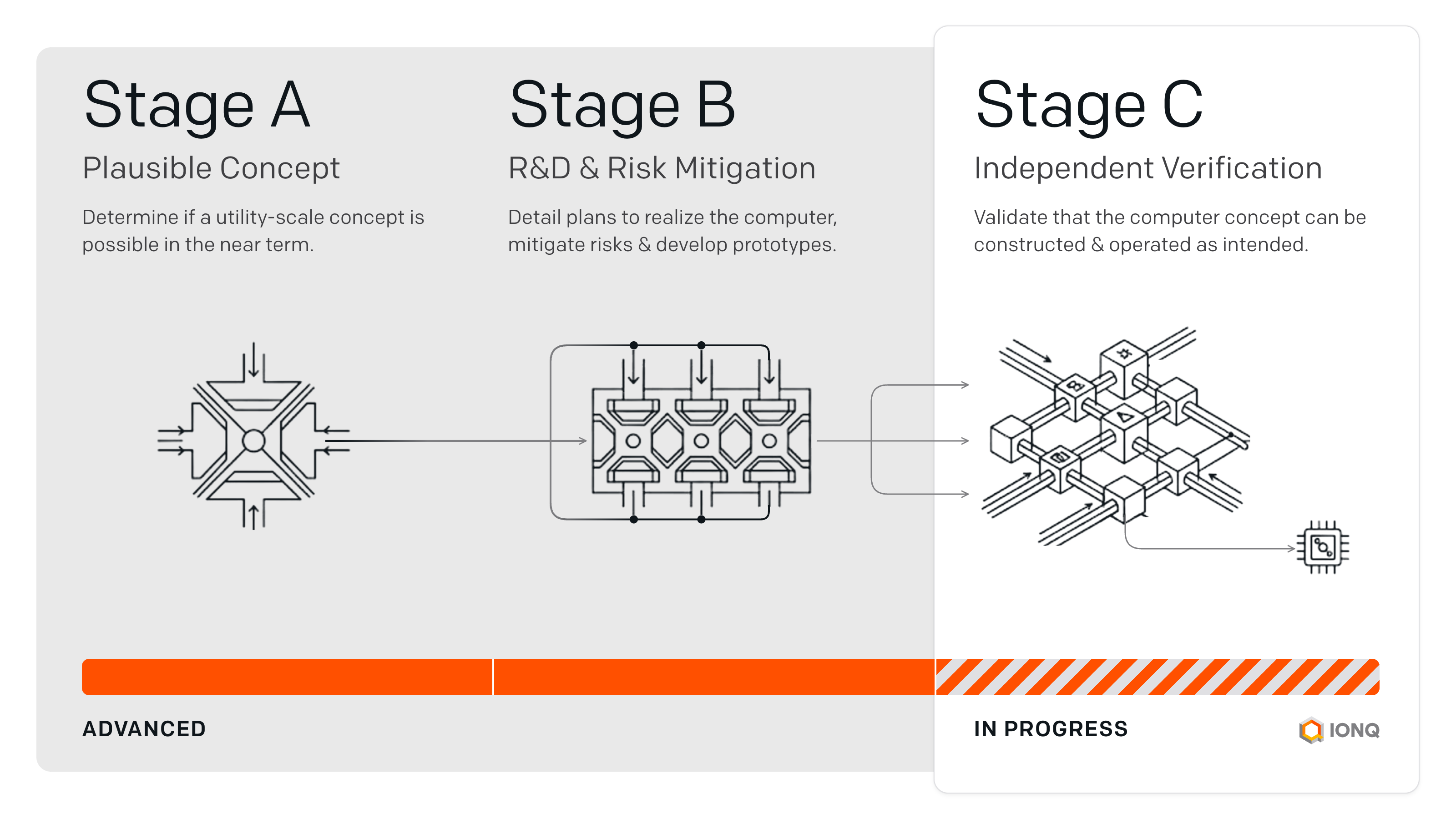
IonQ has now been selected to advance to Stage C of QBI, the initiative’s final and most rigorous phase. It’s a major milestone for IonQ: under an agreement with a potential value of up to $300 million, DARPA will independently evaluate multiple generations of our Superion quantum computers through 2029, testing whether the engineering roadmap we’ve laid out holds up in practice.
We’re proud to have reached this stage. But what makes QBI especially important is that it is bigger than any one company. It establishes a rigorous, independent way to test whether a roadmap toward utility-scale quantum computing is credible, and whether demonstrated technical progress delivers real value.
What does “utility scale” actually mean?
Building a quantum computer that provides more value than it costs is called “utility scale.” While this may sound like another piece of quantum jargon, I like the way DARPA’s question defines it.
Think of “computational value” as the economic benefit you get from having the quantum computer perform a computation. In other words, the goal isn't just to build a quantum device with more qubits or achieve an impressive result in the laboratory. It's to build a machine that delivers more value than it costs.
That is a hard standard, and the right one.
Before IonQ, I directed IARPA, and before that, ran the quantum information program at Sandia, so I’ve seen programs like this from the government side. What I took from that experience is that hard technical problems like this benefit from clearly defined goals and rigorous external evaluation. You need to know what success means, and you need evidence that you’re getting closer to it.
QBI provides both through three stages. Stage A asks whether you have a plausible concept for building a utility-scale quantum computer. Stage B asks whether you can develop a detailed R&D plan for realizing it, identify the risks and explain how you intend to mitigate them. Stage C is where that roadmap meets independent verification and validation.
From individual results to an engineering roadmap
In October 2025, we demonstrated trapped-ion two-qubit gates with fidelity above 99.99%. This past April, we published Walking Cat, an architecture for turning high-performance trapped-ion hardware into a fault-tolerant quantum computer. More recently, we showed how Shor's algorithm could be optimized and compiled onto that architecture to solve the elliptic-curve discrete logarithm problem underlying Bitcoin's ECDSA signatures.
Those may sound like separate technical achievements. They’re better understood as successive pieces of the same engineering problem, each answering a different question.
First, can our hardware perform the underlying operations with extremely low error rates? If we can, how do we architect that hardware into a fault-tolerant computer? And if we have that architecture, what happens when we try to map an extremely demanding algorithm—the thing that actually provides value to someone—onto it?
The last question is particularly important. The value of our elliptic-curve work was in connecting an important algorithm to a specific machine architecture and getting a more concrete picture of what it would take to run the computation. It wasn’t an attack on cryptography. It was a resource estimate: a concrete assessment of what the computation would take on a future machine. We measured, effectively, the cost portion of the cost-value equation.
Each step makes the problem less abstract. QBI Stage C adds a fourth question: how well does that engineering path hold up?
Independent verification is the point
During Stages A and B, IonQ shared prototype hardware data and our technical roadmap with DARPA. Stage C moves from evaluating that roadmap to putting it to the test.
Advancing to this milestone does not mean the engineering is finished. It means our approach has progressed through the first two rigorous stages and is ready for the hardest part: independent evaluation of successive generations of our systems against the roadmap we’ve laid out.
That kind of platform-agnostic testing matters well beyond IonQ. Quantum computing is full of sophisticated technical claims that can be difficult to compare across architectures. Testing systems against real-world problems gives government, industry, and researchers a common basis for distinguishing promising roadmaps from demonstrated progress—and for determining whether that progress can ultimately deliver useful computational value.
A race without a finish line
There is a tendency to describe quantum computing as a winner-take-all race. I understand the metaphor, but I've never thought it captures the challenge particularly well.
There is, however, a very real competition underway. The United States and like-minded nations are competing with China for leadership in quantum technology, and staying ahead matters enormously for our economic competitiveness and national security. But in that competition, the relevant “we” is bigger than IonQ or any single company. It’s the broader U.S. and allied quantum ecosystem.
At the company level, however, the race metaphor is less useful because it implies a single finish line and a single winner. When the first company demonstrates a utility-scale quantum computer, everyone else will not simply go home. The leader will keep innovating, competitors will keep building, and the capabilities of these systems will continue to advance. Reaching utility scale will be an extraordinarily important milestone—for the company that gets there and for the country that leads—but it will not be the end of the race.
That's another reason I think QBI matters. U.S. leadership in quantum cannot rest on any company simply asserting that its technology will deliver. It requires demonstrating, through rigorous and independent evaluation, which technical approaches can perform as promised.
The quantum industry has spent years laying out roadmaps for computers that can tackle problems beyond the practical reach of today's machines. Getting there requires more than each of us making the case for our own technology. It requires building the systems and showing that the pieces actually work together.
There is still hard work ahead. But in a competition this important, leadership has to be demonstrated, not simply declared. Stage C is where we put our roadmap to the test and show that it holds up.
###
A Note Regarding Forward-Looking Statements
This article contains forward-looking statements. All statements contained in this article other than statements of historical fact are forward-looking statements, including statements regarding the potential contribution of quantum technologies, the expected benefits and the mutual reinforcement of combining different space technologies, and IonQ’s continued development of such technologies. In some cases, you can identify these statements by forward-looking words such as “advancing,” “build,” “contribute,” “help,” “can,” “could,” “next,” “become,” and other similar expressions. These statements are only predictions based on our expectations and projections about future events as of the date of this article and are subject to a number of risks, uncertainties and assumptions that may prove incorrect, any of which could cause actual results to differ materially from those expressed or implied by such statements, including, among others, those described under the heading “Risk Factors” in our annual Report on Form 10-K for the year ended December 31, 2025 and our Quarterly Report on Form 10-Q for the quarter ended June 30, 2026 filed with the Securities and Exchange Commission. New risks emerge from time to time, and it is not possible for our management to predict all risks, nor can management assess the impact of all factors on our business or the extent to which any factor, or combination of factors, may cause actual results to differ materially from those contained in any forward-looking statement we make. Investors are cautioned not to place undue reliance on any such forward-looking statements, which speak only as of the date they are made. Except as otherwise required by law, we undertake no obligation to update any forward-looking statement, whether as a result of new information, future events or otherwise.

